
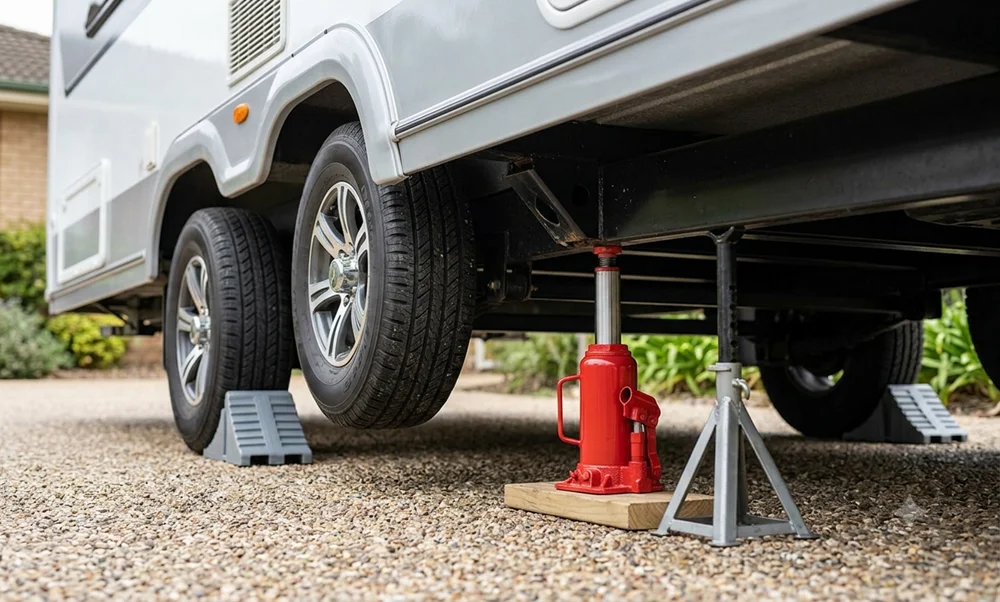
How to Safely Lift a Caravan, Trailer or 4WD with a Hydraulic Jack
If you’ve never lifted a heavy vehicle before, it can be a scary experience. When your tyre has a puncture, 4WD gets stuck and you are out of town, or a trailer requires attention, you are left standing there with no idea of what to do. But, don’t despair, it’s not difficult if you have the correct hydraulic jack and a little care.
This guide is designed to take you through all of the information that you need to know when using hydraulic jacks on trailers, caravans and 4WDs. We will be simple and clear, even if you have never operated a jack before, you will know exactly what to do.
Why Hydraulic Jacks are the go-to choice?Why is it that Hydraulic Jacks are the go-to choice?
The hydraulic jacks are popular due to its capacity to lift hefty loads with very little exertion. You press a leaver up and down, causing the lever to lift the weight incrementally. This is much easier than old fashioned screw jacks which require quite a bit of muscle effort to operate.
A caravan hydraulic jack should be able to raise thousands of kilograms with a smooth and steady lift. It is very important if you are driving a loaded caravan or a large 4WD as jerky lifting may cause injury.
The typical range for the weight of most modern caravans and camper trailers is between 1,500kg and 3,500kg when fully loaded. Some off-road 4WDs, which are already large, weigh in at nearly 3,000kg. It’s a lot of weight on a little jack and it really does mean to use the right tool.
Selecting the proper Jack for the job
Not all jacks are created equal. Before purchasing or use one, check the following three things.
Weight capacity.
Always use a jack with a capacity greater than the load it has to lift. If your caravan is 2,500kg, then your jack is just barely good enough. Try to have a little extra buffer so that the jack is not operating at full capacity.
Lift height.
Some will sit down to the ground and big 4WDs will be sitting much higher. When shopping for a jack be sure to look at the minimum and maximum height range for the jack to ensure that it fits under your vehicle.
Jack type.
Bottle jacks are tall, narrow, ideal for high ground clearance vehicles. The trolley jack (or floor jack) is a wider jack that is easier to roll into position, and is frequently a better choice for caravans or trailers on flat surfaces.
The importance of preparing before lifting.
The quickest way to upsetting the step is to hurry through it. It’s a case of a little preparation goes a long way.
First, park on level ground on solid ground. Do not place a vehicle on a grassy surface, sand, gravel or incline when attempting to lift. The jack may tip over if the ground is soft or uneven when the vehicle is hoisted.
Second, apply the handbrake and put wheel chocks behind the wheels that are staying on the ground. This will prevent the caravan/trailer rolling when working under.
Thirdly, if the trailer or caravan is attached to a tow vehicle, do not disconnect it unless it is necessary. This provides added stability while lifting.
Fourth, examine the jack itself. Look for any leaks, cracks or damage. You don’t want a hydraulic jack that is worn out to carry thousands of kilograms of weight.
Step by Step: How to Lift Safely (English)
After setting up, take time to go through these steps in detail.
- Identify the right jacking point of your caravan, trailer and 4WD. Refer to the owner’s manual as jacking at the wrong point could bend or damage the chassis.
- Put the jack under the jacking point ensuring it is flat and centred.
- Slowly pump the jack handle. Observe the vehicle as it ascends and immediately stop if it appears to be leaning or wobbling.
- Lift only as high as you need. No need to lift the vehicle to any greater height than it is needed to be for the task.
- Keep a jack stand or firm support under the vehicle when it is off the ground and before performing any maintenance or repairs. Never use the jack to support the load.
- After the job is completed, take off the jack stand, and then, slowly lower the jack with its release valve. Do it gently; not at once.
The common pitfalls that people fall into.
Seasoned caravan and 4WD drivers can make mistakes here. Be careful of these mistakes.
- An undersized jack is an error of the greatest magnitude. May appear effective initially but can suddenly break down at times of stress.
- Placing a vehicle on a jack, rather than on a jack stand, is another risky practice. Jacks will loosen or lose pressure with time, always use a proper stand as back-up support.
- Accidents also frequently occur when lifting on soft or uneven ground. If it tilts over at all, it can turn the entire system unstable.
- This is a common error that may result in the trailer rolling while it’s being serviced.
Taking Care of Your Hydraulic Jack
With proper maintenance, a hydraulic jack for caravan and trailer use will last a lot longer.
Keep it in a dry area as moisture may rust and lead to seal damage. Release and check the level of hydraulic fluid on a regular basis, about every few months, and top up if low. Do not let moving parts become over lubricated and cause them to seize over time.
It also aids in periodically testing the jack even if it isn’t being used for an actual job. Pump up and down a couple of times to ensure smooth movement of internal components.
When to Get Professional Help
Not every situation is a do-it-yourself job. If your caravan or 4WD has suffered damage, if you are unsure about the correct jacking points, or if the ground conditions are tricky, it is worth calling a professional mechanic or roadside assistance service.
There is no shame in asking for help. A jack failure can cause serious injury, and it is always better to be safe than sorry.
Final Thoughts
Lifting a caravan, trailer or 4WD with a hydraulic jack is a simple task once you understand the basics. Choosing the right hydraulic jack for trailers, checking your ground and jacking points, and always using a stand for extra safety will keep you protected while you get the job done.
Take your time, follow each step carefully, and never skip the safety checks. A few extra minutes of preparation can save you from a lot of trouble down the road.


