










If modern B2B marketing already has the platforms, automation, and channels, why does execution still fall apart?
The real point of differentiation now lies elsewhere: in the accuracy, depth, and usability of the data that powers those systems. When contact and account records are incomplete, stale, duplicated, or structurally inconsistent, execution quality declines across the funnel. Targeting weakens, lead qualification becomes unreliable, personalization loses relevance, and attribution starts reflecting system noise rather than market reality.
This blog dives into how data enrichment strengthens B2B marketing, best practices for B2B data enrichment, and how data enrichment services help. Let’s begin!
Why Raw B2B Data Fails Under Modern Marketing Demands?
B2B marketing relies heavily on personalization, account-based engagement, and coordinated execution across connected systems. Raw B2B data often falls short because it is static, incomplete, and fragmented across systems, which limits targeting precision, lead qualification, and campaign orchestration.
This gap is driven by three core limitations:
- Rapid Data Decay: DemandGen’s 2026 Database Strategies & Contact Acquisition Benchmark Survey states that 42% of databases are decaying faster than they are replenished.
- Lack of Behavioral Intelligence: Raw records may capture basic account attributes, but they rarely indicate buying readiness or near-term intent.
- Data Fragmentation Across Systems: Customer and account data often remains distributed across CRM, marketing automation, and sales platforms without consistent standardization, resulting in duplicate records, missing fields, and a fragmented account view.
The result is not merely inefficiency; it also leads to distorted execution.
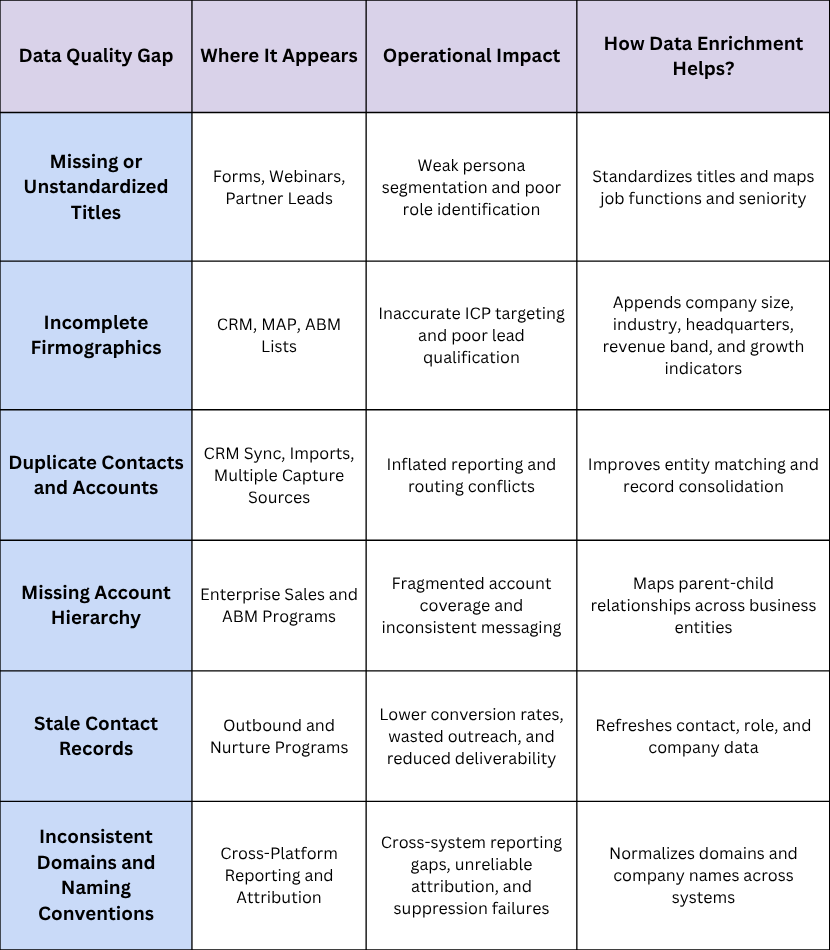
How Data Enrichment Strengthens Core B2B Marketing Workflows?
1. Lead Qualification and Routing
Lead qualification becomes unreliable when records lack standardized titles, verified company data, or a clear account context. Data enrichment strengthens this workflow by appending and normalizing the attributes required to assess account fit, buying committee role, and routing priority.
2. ICP-Based Segmentation and Targeting
Data enrichment enables more precise audience segmentation by appending structured firmographic, technographic, and account-level attributes such as industry, employee size, geography, account hierarchy, and technology stack. This allows marketing teams to define audiences based on ICP fit, improving campaign relevance, and reducing spend on low-fit accounts.
For example, instead of targeting a generic segment such as mid-sized software companies, an enriched dataset allows teams to isolate SaaS companies in North America with 100–500 employees, using Salesforce, and operating under a parent enterprise account.
3. Hyper-Personalization
Personalization in B2B marketing depends on business context, not just contact identity. Data enrichment enables more precise messaging by adding account, role, and company-level intelligence that helps marketers reference specific pain points, technology stack, and recent business developments. This improves message relevance across email, paid media, nurture programs, and account-based campaigns.
4. Account-Based Marketing (ABM)
ABM focuses on targeting high-value accounts through personalized outreach to key decision-makers. Data enrichment enhances this by improving account mapping, identifying parent-child relationships, and uncovering the buying group’s composition. As a result, marketing and sales teams can implement targeted account strategies that engage all relevant stakeholders, driving stronger sales and marketing alignment.
The Integral Role of Data Quality Management in Marketing Data Enrichment
| “Data enrichment with poor data governance exacerbates inconsistencies and operational inefficiencies.” |
Inconsistent naming conventions, weak duplicate handling, unclear ownership, and poorly managed synchronization logic lead to further fragmentation. When these issues remain unaddressed, enriched records simply add another layer of complexity and inconsistency, undermining the overall effectiveness of marketing operations.
A mature data enrichment strategy combines enrichment with data quality management across four key areas:
- Data Standardization: Ensures that records follow consistent formatting and structural logic.
- Data Validation: Verifies that critical data fields remain accurate and usable for activation, enhancing targeting, and lead qualification.
- Data Deduplication: Ensures clean, accurate data by removing duplicate records, which improves attribution accuracy, enhances reporting reliability, and streamlines lead routing.
- Data Governance: Ensures compliance with regulations like General Data Protection Regulation (GDPR), California Consumer Privacy Act (CCPA), and Health Insurance Portability and Accountability Act (HIPAA) to ensure data integrity and security across systems.
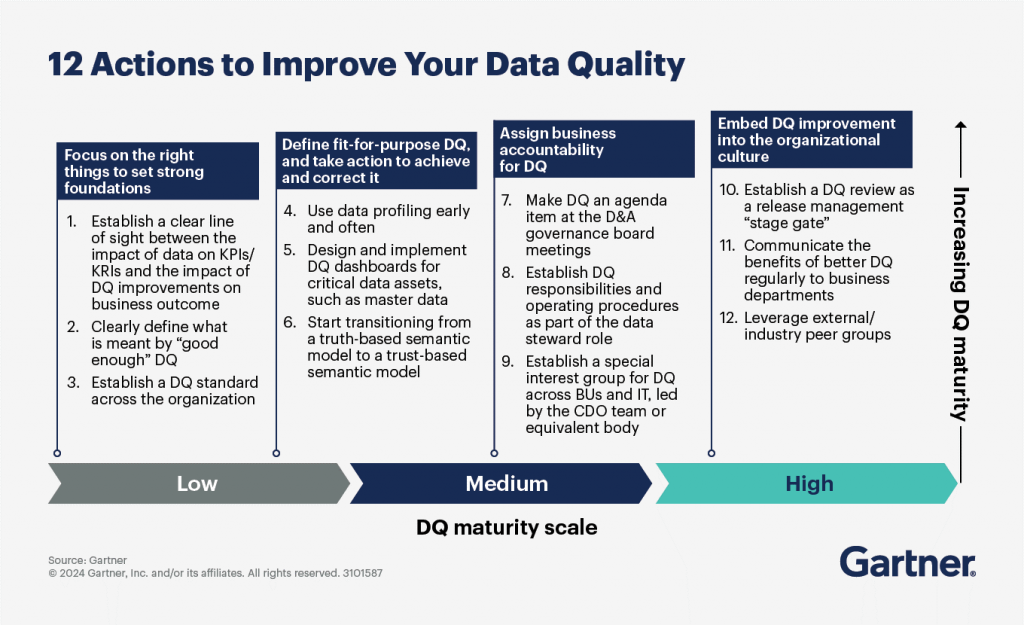
Source: Gartner
Best Practices for B2B Data Enrichment
1. Define Clear Objectives
Establish specific objectives for data enrichment—such as improving lead scoring, enhancing segmentation, and driving personalization. Ensure that enrichment aligns with broader business goals to measure its impact effectively.
2. Ensure Data Standardization and Cleansing
Standardize and clean enriched data regularly to eliminate duplicates and inconsistencies. This ensures high-quality data for accurate segmentation, targeting, and decision-making.
3. Ensure Compliance with Data Privacy Regulations
Adhere to regulations such as GDPR, CCPA, and other compliance such as HIPAA to ensure data security & integrity.
4. Enable Cross-Channel Integration
Integrate enriched data across CRM, MAP, and advertising platforms to enable consistent, personalized messaging across all customer touchpoints.
5. Track and Monitor the Performance
Monitor key performance indicators (KPIs) like conversion rates, engagement, and ROI to assess the effectiveness of data enrichment and optimize strategies accordingly.
The Business Case for Data Enrichment: In-house teams often struggle with scalability, data volume, and access to third-party sources due to limited internal resources and infrastructure. B2B data enrichment services offer scalability, access to diverse data sources, data accuracy, and cost-effectiveness.
By outsourcing data enrichment services, businesses can tap into broader data sources and improve targeting, leading to more efficient marketing and reduced operational costs.
Author Bio:
 Brown Walsh is a content analyst, currently associated with SunTec India– a leading multi-process IT outsourcing company. Over a ten-year-long career, Walsh has contributed to the success of startups, SMEs, and enterprises by creating informative and rich content around topics, like data annotation, image annotation and video annotation services. Walsh also likes keeping up with the latest advancements and market trends and sharing the same with his readers.